
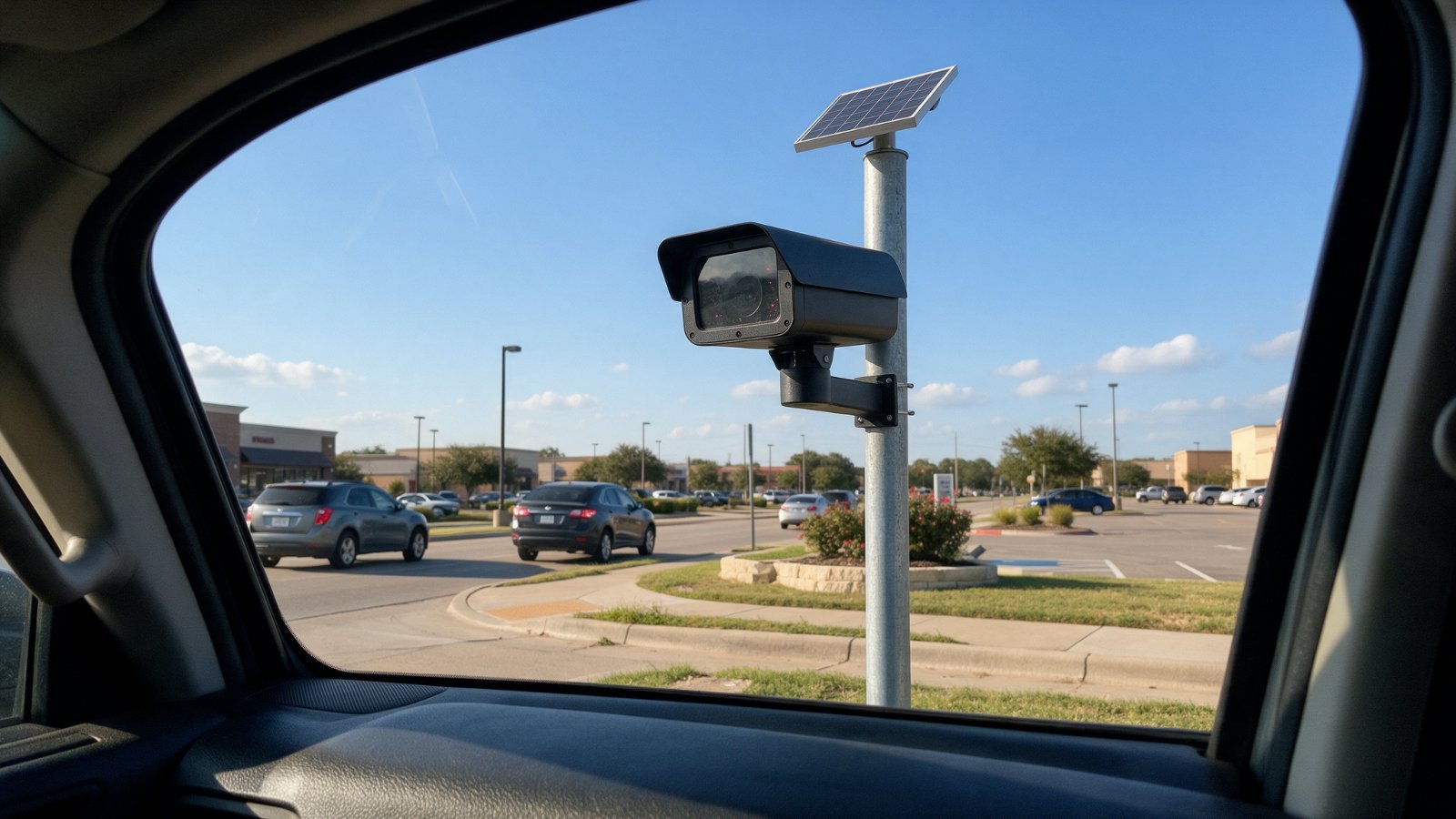
If you saw the headlines earlier this month, you probably thought Dallas was done with Flock cameras. We did too. Then the city started rolling out AI cameras on garbage trucks that photograph houses on their routes. So we did the digging to see what is really going on.
Here is the short version. Dallas never dropped Flock. And the trash truck cameras are a whole separate program. That means Dallas residents are not getting less surveillance. They are getting more.
What Really Happened With Flock in Dallas
Governor Greg Abbott blocked state agencies from using state money on Flock cameras. Dallas had been paying for part of its network with a state grant, so the Dallas Police Department shut off 321 cameras on September 15. That is where the “Dallas cancels Flock” headlines came from, according to Axios Dallas.
But the city kept over 300 cameras running. On September 3, Council Member Adam Bazaldua proposed cutting the $1.5 million the city spends on Flock and moving that money to infrastructure and eviction help. The council shot it down. Only three of the 15 members voted to end the program, per KERA and CBS Texas.
Bazaldua also pointed out two things every Dallas resident should know. Dallas keeps Flock data for a full year, and it shares that data with more than 50 other agencies. In his words, “We cannot control who has access to our technology.”
Then Came the Trash Trucks
The garbage truck cameras are not Flock. They come from a company called City Detect, and the city uses them for code enforcement, things like overgrown yards, junk and illegal dumping. The council approved a contract worth about $2.55 million over three years, with cameras going on sanitation trucks in early 2026, according to NBC 5. The city says faces and license plates get blurred before staff ever see the images.
The numbers are wild. In the first four months, the system flagged more than 20,000 possible code violations. Only 57 turned into citations. About 68 percent of those citations landed in three council districts that are mostly Black and Hispanic, per Gadget Review and the Dallas Observer. And the big questions are still unanswered: how long the photos are kept, and whether police can get their hands on them.
So it is not a straight bait and switch. It is worse in a way. Dallas kept most of its license plate cameras and added a second set of cameras that roll past your house every week.
This Technology Has Been Abused Over and Over
Supporters of Flock always say it is a tool for catching criminals. But the tool has been turned on regular people again and again, and a lot of the time the person doing it was a cop. Here are just some of the cases that have been made public:
- Shively, Kentucky: Officer Asad Zahir is accused of searching his ex girlfriend on Flock 2,048 times between January and May of this year, including 241 searches after she got an order of protection. He allegedly logged the searches as drug investigations. He was arrested in August and charged with official misconduct and unlawful access to a computer, per ABC15.
- Kechi, Kansas (Sedgwick County): Lieutenant Victor Heiar used Flock to track his estranged wife’s location. He was arrested in 2022 and pleaded guilty to stalking and computer crime charges, according to the Sedgwick County District Attorney.
- Sedgwick, Kansas: Police Chief Lee Nygaard ran his ex girlfriend’s car through Flock 164 times and her new boyfriend’s car 64 times in 2023, then followed them in his patrol car. He resigned and lost his certification. No criminal charges were filed, per AOL.
- Menasha, Wisconsin: Officer Cristian Morales used Flock’s nationwide network off duty to track his ex girlfriend’s car. He was sentenced in August to six months in jail and three years of probation, per the Wisconsin Examiner.
- Milwaukee, Wisconsin: Officer Josue Ayala used Flock on duty to track two people, including a romantic interest, using vague search reasons with no case numbers. Then the internal affairs detective investigating him, Tehrangi Chapman, was charged with his own misconduct and GPS misuse case, per the Wisconsin Examiner. The person checking the cops needed checking too.
- Johnson County, Texas: This one is right in our backyard. In May 2025, the Johnson County Sheriff’s Office searched 83,345 Flock cameras across the country looking for a woman. The sheriff and Flock said she was a missing person and they were checking on her welfare. Records obtained by the Electronic Frontier Foundation showed it was being handled as a death investigation over an abortion, and deputies talked to prosecutors about possibly charging her.
There Are No Guardrails
Anybody who has worked in tech knows how this is supposed to work. On a server, every login and every action is recorded in an access log. If someone pulls data they should not touch, there is a trail, and somebody whose whole job is security is watching it.
Flock has audit logs too. Every search records the plate, the officer, and a reason. The problem is that the reason is just a text box. The Kentucky officer typed in drug investigation. The Milwaukee officer used vague terms with no case number. The system took their word for it.
And look at how most of these cases got caught. A victim told a friend who went to another police department. A tip. An internal investigation. In Shively, it took a new AI audit tool flagging the pattern after more than 2,000 searches. In almost every case, the abuse was found after the damage was done, not stopped while it was happening.
So who is actually enforcing this? Who at the City of Dallas is reading those logs? Is it the same department running the searches? Because if the police are the only ones checking on the police, that is not oversight. That is the honor system.
Why Sites Like Have I Been Flocked Matter
Since the cities are not doing much to show us how this data gets used, regular people started doing it themselves. Have I Been Flocked is a free, donation funded site run under a nonprofit that collects Flock audit logs through public records requests and city transparency portals. You type in your plate and see if it shows up in a search, along with the reason given and who ran it.
The site is upfront that its data is incomplete. It only has what cities release, and a lot of it comes back redacted. It also cannot tell you every time you drove past a camera. It only shows when someone searched you. But that is exactly the point. It is the public doing the watching that the system is supposed to do. The fact that it has to exist tells you everything about how much real oversight there is.
Our Prediction: Breaking Your Pattern Becomes the Crime
Here is where it gets scary. Think about someone who lives in DFW, works in DFW, and gets scanned by the same cameras every day. The system learns their routine. Then one weekend they drive down to the Valley to see family, or cross into Mexico. Suddenly their car is somewhere it has never been, on a road police call a drug route.
This is not just a theory. In November 2025, the Associated Press reported that Border Patrol runs a license plate reader program that flags drivers based on where they came from, where they were going and which route they took. Short trips to the border region can get you flagged. The agency calls it “patterns of life” analysis, and its cameras reach cities like San Antonio and Houston.
When a car gets flagged, Border Patrol tips off local police, who find a reason to pull it over. These are called whisper stops. A Texas deputy told the AP, “The beautiful thing about the Texas Traffic Code is there’s thousands of things you can stop a vehicle for.” Speeding, tint, a missed signal. The flag is the real reason. The ticket is the cover story.
Alek Schott found that out in 2022. He took an overnight trip to Carrizo Springs, about 80 miles from the border, and got stopped outside San Antonio on the way back. He was held over an hour and his truck was searched. Nothing was found. Later, messages showed Border Patrol agents had set up the stop.
Legally, taking a trip is not probable cause for anything. But when a computer calls your road trip suspicious and an officer is told to find a reason to stop you, the end result feels the same. Now picture that same pattern matching running on a year of Dallas driving data shared with more than 50 agencies.
Questions for the City of Dallas
We want to support public safety. But Dallas residents deserve real answers before one more camera goes up:
- Who at the city reviews Flock audit logs, how often, and is it anyone outside the police department?
- Has any Dallas officer ever been investigated or disciplined for misusing Flock? How many?
- Does Dallas require a case number for every Flock search, or can officers type any reason they want?
- Why does Dallas keep plate data for a full year, and which of the more than 50 agencies can see it? Does that include federal immigration or border agencies?
- Will Dallas publish its Flock audit logs on a public transparency portal like other cities do?
- Is Dallas Flock data being used for travel pattern analysis or shared with anyone who does that?
- How long does the city keep trash truck photos, and can police request them?
- Why are 68 percent of trash truck citations landing in three mostly Black and Hispanic districts?
- What stops a camera program built for code enforcement from quietly turning into a policing tool later?
The Bottom Line
Dallas did not step back from surveillance this month. It kept its license plate network, added cameras to its trash trucks, and still has not explained who is watching the people doing the watching. Across the country, this technology has been used to stalk exes, track a woman over an abortion and flag drivers for taking a road trip. Until there are real rules with real enforcement, every Dallas resident should be asking who is looking at their data, and why.